AI can help a person build health between visits, and it works only when the person trusts it with the truth. Health is created from the inside out, and a person changes fastest when someone notices what they are doing right.
This post describes the philosophy behind the EverBetter Sovereign Health Loop™. Our cofounder, Dr. David Haase, shaped it. My work as CTO is the platform that makes it trustworthy, and the second half of this post explains how.
Creating health begins with knowing yourself. From there, a person grows through learning, shows themselves to others on their own terms, and settles into a life that flows. Knowing yourself depends on feedback. A feedback loop tells you what you want, what you are doing, and how well the two fit.
Feedback arrives from two directions. Encouragement works from the outside in. Think of a child who grows up noticed: caught doing good things and recognized for them. That child tends to turn out fine, even after a hard start. A small amount of recognition changes a trajectory. In the loop, the care team and the system play that role. When Maria’s sleep improves for three nights, or she cuts the late-night sugar she named as her trigger, the loop notices the fit between what she wants and what she did, and it says so.
Gratitude works from the inside out. It is the practice of noticing the good in front of you: a full breath, light through the trees, a body that carried you through the day. Gratitude belongs to no single tradition, and it pulls a person into the experience of their own life. When Maria catches herself doing well, the recognition comes from her own voice. That voice lasts longer than any outside reward.
The loop is deliberately light on negative feedback. It offers a correction only when the person sets that rule for themselves. Negative reinforcement teaches people to avoid the signal, and avoidance creates new problems on the side. Strength-based design increases what already works, and it does not set up that chain of side effects.
Our clinical framework names five ways to create health: bring in helpful resources, remove detrimental causes, retrain dysfunctional patterns, repair what is damaged, and rejuvenate what has aged. Gratitude is an internal resource. Encouragement is an external one. Each step the loop suggests must be simple and achievable, so the system never sets a person up to fail.
The research supports this emphasis. In a randomized trial, people paid to lose weight lost far more than controls in 16 weeks, and the difference was no longer significant months after the payments stopped [1]. Outside rewards work while they run. Gratitude has promising and incomplete evidence: in one set of experiments, people who kept a weekly gratitude list exercised more and reported fewer physical complaints [2], and later studies have not always replicated the physical effects [3]. Our research is producing the data to test it inside the loop.
Feedback only works when a person trusts its source. Advertising platforms already read people closely enough to predict their next impulse, and they use that knowledge for someone else’s benefit. A person who suspects that their words will leak stops writing the true ones. That is why sovereignty comes first in our architecture.
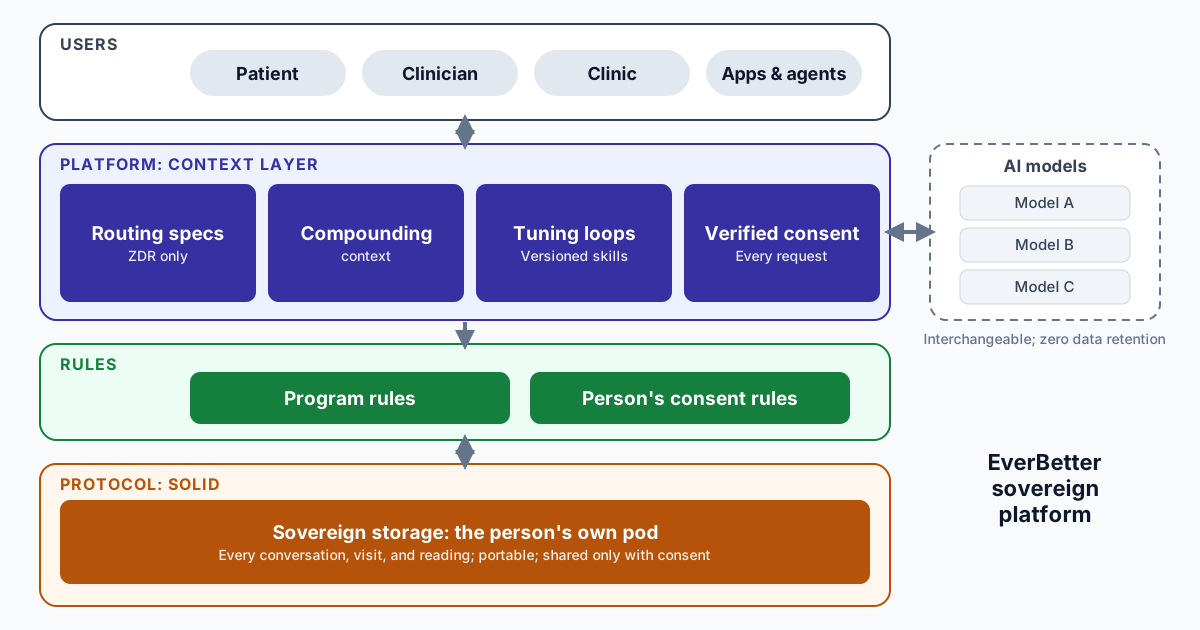
The EverBetter sovereign platform places a proprietary context layer between the person and every AI model, and that layer does five jobs. Routing specs, written as verifiable rules, send each request only to models that run under zero data retention, where the provider does not store prompts or responses after it returns an answer [4]. Context compounds: each program’s knowledge and the person’s history carry forward instead of resetting every session. Tuning loops hold each program’s rules, including the strength-based rules above, as versioned skills that improve with every cycle. Verified consent applies a machine-checkable rule to every request, so a role, a model, or an app sees only what the person allows. Sovereign storage writes every conversation, every visit, and every reading into the person’s own Solid pod.
That pod is the point. Every visit, and every day between visits, adds to a health history that belongs to Maria, and no one sees it without her consent. The models are interchangeable; her history is portable. When a better model arrives, we route to it, and her history stays where it is. Any other app Maria chooses can work with her data under the same consent rules.
Our intellectual property is the loop: the specifications, the verification, and the skills that improve with every cycle. Prompts reset every session; loops compound [5].
The result is an AI that brings the world’s knowledge to Maria and keeps nothing of hers. The model sees only what her consent allows, for the length of one request. Her data stays home.
We also design against a quieter risk. A system that does all of a person’s thinking lets their judgment weaken. The loop prompts Maria to notice, choose, and reflect, so her own capacity grows alongside the support.
Every visit counts. Every good night of sleep between visits counts too.
Chris “Buzz” O’Neil is CTO of EverBetter.
[1] K. G. Volpp, L. K. John, A. B. Troxel, L. Norton, J. Fassbender, and G. Loewenstein, “Financial incentive-based approaches for weight loss: A randomized trial,” JAMA, vol. 300, no. 22, pp. 2631–2637, Dec. 2008. [Online]. Available: https://jamanetwork.com/journals/jama/fullarticle/183047
[2] R. A. Emmons and M. E. McCullough, “Counting blessings versus burdens: An experimental investigation of gratitude and subjective well-being in daily life,” J. Pers. Soc. Psychol., vol. 84, no. 2, pp. 377–389, 2003.
[3] Greater Good Science Center, University of California, Berkeley, “The Science of Gratitude,” white paper for the John Templeton Foundation, 2018. [Online]. Available: https://www.templeton.org/wp-content/uploads/2018/05/Gratitude_whitepaper_fnl.pdf
[4] Anthropic, “API and data retention,” Claude Platform Docs. [Online]. Available: https://platform.claude.com/docs/en/manage-claude/api-and-data-retention
[5] L. Beliūnas, “Loop Engineering: How to Design AI Loops That Build, Ship, and Improve While You Sleep,” Linas’s Newsletter, Jun. 10, 2026.