Every engineering organization says it is moving fast. Most measure fast in sprints. We measure the efficiency of PRs. Each generation of AI development has decreased the time between a PR and a customer receiving that capability. The latest generation has taken us from days to minutes.
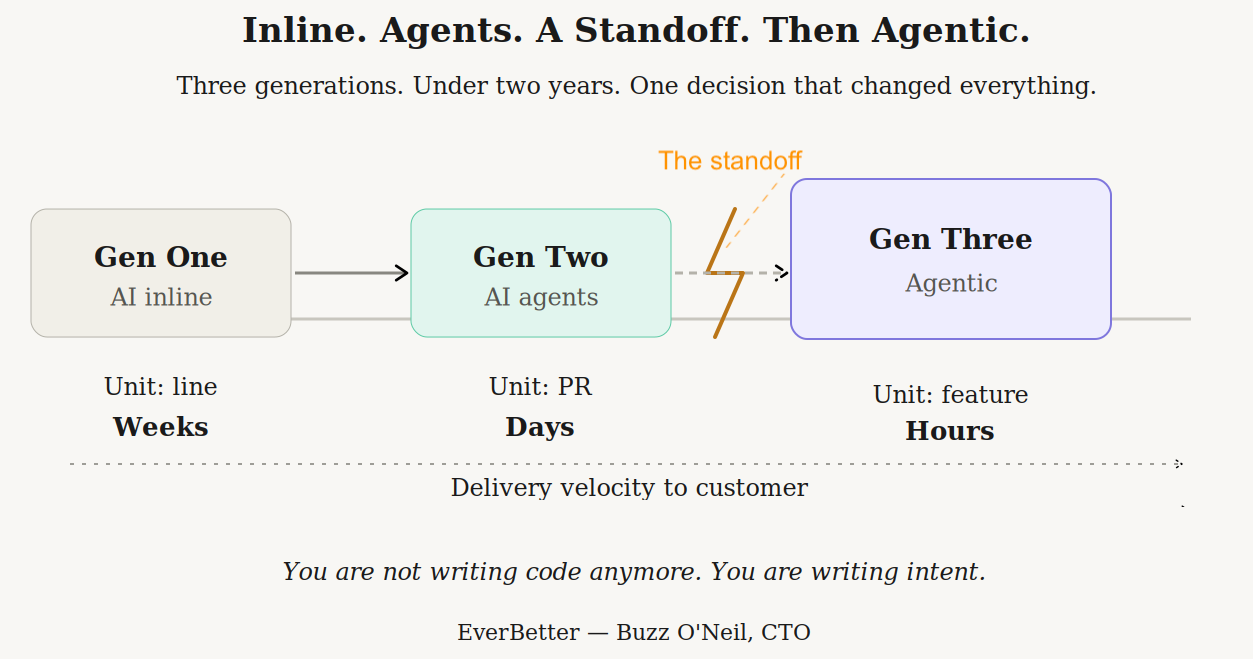
But the path from inline AI to fully agentic was not a straight line. There were three generations, a generational collision at the handoff boundary, and a standoff that forced a choice: retreat to Gen Two or commit to Gen Three. We committed. Each generation is defined not by when it happened, but by what the unit of work became — and the standoff is where we discovered exactly what that meant.
We are not telling this story because we finished it. We are telling it because our customers are living the result of it. EverBetter is an AI-native organization. We adopted each generation as it arrived, we are fully committed to agentic now, and we will adopt whatever comes next. Loyalty is not to the tool. It is to the delivery to the customer.
This is not a roadmap. It is a record of what actually happened, and a statement of where we are going.
§ 1. Gen One: The Augmented Developer
The unit of work was the line.
Four engineers. AI autocomplete. Six months. Five hundred thousand lines of production code delivered to a platform serving real patients and clinicians.
The engineer was still the engine; the AI was the accelerant. Every decision flowed through a human, every commit carried a human fingerprint. PRs moved in days. The stack was larger than any four-person team had a right to build, and we built it. Customers got features they could not have gotten any other way at that team size.
The output was extraordinary by any prior standard. It was also, in retrospect, the last moment the individual developer was the atomic unit of production and the last moment days was an acceptable unit of delivery time.
§ 2. Gen Two: The AI-Assisted Team
The unit of work became the pull request.
The team scaled to twenty offshore engineers augmented with AI tooling. The output scaled with it: ten million lines in six months. The leverage ratio shifted from individual productivity to coordinated throughput. Engineers reviewed, steered, and integrated; the AI filled the gaps among them. PR volume increased; delivery cadence to customers accelerated.
The two sides of the team diverged in how they engaged the AI. The onshore team instrumented GitHub Actions with deep AI agents and sub-agents: purpose-built, wired into the pipeline, operating with defined scope and context. The offshore team used Claude but kept it general-purpose; no dedicated agent harness, no sub-agent architecture, prompt-and-respond at the task level. Both approaches produced code. Only one produced the infrastructure that Gen Three required.
This was not a mere staffing change. It was a structural one. The cognitive load of any single engineer fell; the orchestration load of the engineering organization rose. The humans were still in the loop, but the loop was getting wider and the features reaching customers were getting more numerous. Underneath that loop, however, the two teams were already in different generations without knowing it.
§ 3. The Standoff
Then the loop broke. This is the moment the title is about.
A 5,000-line pull request arrived from the onshore team. It came packaged with its own agent harness and a complete test suite. The offshore engineers examined it, declared it non-functional, and refused to use the agent harness to investigate.
They were not wrong to be confused.
They were applying Gen Two judgment to a Gen Three deliverable.
The agent harness was not decoration; it was the interface. Refusing to run it was the equivalent of receiving a compiled binary and insisting on reading the assembly by hand. The mismatch was not technical. It was epistemic. The offshore engineers lacked the mental model to know what they were looking at, let alone how to engage it. Customers waited while that mismatch got resolved.
The standoff forced a choice: scale back the Gen Three deliverable to meet Gen Two expectations, or hold the line and require Gen Three engagement. We held the line. Everything that follows is the result of that decision.
§ 4. Gen Three: The Agent-Native Organization
The unit of work is now the feature.
One engineer. Obvious.ai Autobuild. Two complete integrations and a full feature spec’d and built in a single day; packaged with full tests and end-to-end coverage in two. The proof of concept is done. The target state is same-day customer delivery: capability conceived, built, tested, and in front of the customer before the day closes.
The arithmetic is almost offensive. Twenty offshore engineers spent six months producing Gen Two throughput. One engineer with Autobuild delivered equivalent feature density in forty-eight hours. The comparison is not about talent. It is about generation. The goal is to close the remaining gap between build completion and customer receipt entirely.
A Gen Three engineer does not write more code than a Gen Two engineer. They write less. Substantially less. They write the thing that tells the agent what the code should accomplish. The agent builds it. The pipeline ships it. The customer gets it. The pipeline step remains manual, for now at least.
§ 5. Autobuild and the Workflow Inversion
Obvious.ai Autobuild represents the moment the agent stops being a tool inside the workflow and becomes the workflow itself.
This distinction matters more than it sounds. In Gen One and Gen Two, the agent assisted. The engineer opened the IDE, reached for the autocomplete, reviewed the suggestion, accepted or rejected. The workflow was human; the AI was peripheral. Delivery timelines were human-paced.
Autobuild inverts this. The engineer writes the intent; the agent resolves it into architecture, implementation, and tests. The engineer does not manage the process. They manage the outcome. Delivery timelines are now agent-paced, measured in hours, not sprints.
EverBetter is phasing out code development and replacing it with prompting exclusively. Every prompt is a direct line between product intent and customer delivery. We are relentlessly removing everything in between.
That sentence should be alarming to any engineer who has not yet made the transition. It should be obvious to any engineer who has.
§ 6. What Survives
The engineers who do not survive Gen Three are not the ones who write bad code. They are the ones who cannot write clear intent.
Code is a lossy medium for intent. It describes the how with great precision but it is a compromise due to the bounds the architecture already drew; the why that drew those bounds is nowhere in the code. Prompting inverts this. The agent handles the how; the engineer is responsible for the why, the what, and the exact shape of the outcome. This requires a different cognitive discipline: not the discipline of implementation, but the discipline of specification. The payoff is direct: better specification means better delivery, and better delivery means customers get more value, faster.
The survivors are the engineers who were always doing product architecture in disguise. Gen Three simply removed the disguise.
EverBetter is not stopping here. We are an AI-native organization, which means we do not pledge allegiance to any specific generation of tooling. We pledged allegiance to the customer. We moved from inline to agents to agentic because each transition put more value in front of our customers faster. When Gen Four arrives, we will move again. Without sentiment. Without hesitation.
You are not writing code anymore. You are writing intent.
And if you are building the posture to move with every generation that follows, you are building an organization that cannot be made obsolete and customers who will not wait on anyone else.